Can you exercise before a health screening? Yes, but it’s better to keep things light. Walking to the clinic is generally fine. A heavy gym session, long run, or intense cycling workout can temporarily change certain blood and urine results.
For routine blood tests, a good rule is to avoid strenuous exercise for 24 hours beforehand. Some tests have different preparation requirements, so always follow your clinic’s instructions.
Key Takeaways
- Gentle walking is usually fine before routine screening.
- Avoid strenuous exercise for 24 hours before blood sampling.
- Hard workouts may affect glucose, liver enzymes, kidney markers, and urine albumin.
- Blood pressure tests need a short rest immediately beforehand.
- Tell your doctor if you’ve exercised hard recently.
Can You Exercise Before Health Screening?
You don’t need to avoid all movement. Normal daily activities, such as an easy walk or household chores, are different from exercise that leaves you breathless or unusually sore.
The European Federation of Clinical Chemistry and Laboratory Medicine (EFLM) recommends avoiding intense physical activity for 24 hours before a blood draw. What counts as intense depends partly on your usual fitness level. An easy jog for a regular runner might be difficult for someone who rarely runs.
If your appointment is tomorrow morning, save heavy weights, HIIT, and long endurance sessions for another day.
You can also check our health screening packages beforehand to understand which blood and urine tests are included in your appointment.
Which Test Results Can Exercise Affect?
Hard exercise can produce genuine, temporary changes in your body. These aren’t necessarily laboratory errors, but they may make your results harder to interpret.
| Test | Possible effect of strenuous exercise |
| Blood glucose | May rise or fall temporarily |
| HbA1c | A single workout has little immediate effect |
| Liver enzymes (AST and ALT) | May increase after heavy muscle work |
| Creatinine and eGFR | May change following prolonged exercise |
| Urine albumin (uACR) | May increase temporarily |
| Blood pressure | Recent activity can alter the reading |
Blood Sugar and HbA1c
Exercise doesn’t always lower blood glucose immediately. An intense workout may briefly raise it, while some activities can lower it during or afterwards. The response varies from person to person.
HbA1c is different. It reflects average blood glucose over roughly three months, so one workout is unlikely to affect the result significantly. HbA1c also doesn’t require fasting.
Liver Enzymes
Heavy lifting can raise AST and ALT, enzymes commonly included in liver function tests. In a small 2008 study, 15 healthy men performed unfamiliar weightlifting. Their AST and ALT levels stayed elevated for at least seven days.
That doesn’t mean everyone needs a week off exercise. It means you should tell your doctor if you recently lifted unusually heavy weights. Elevated liver enzymes still need proper medical assessment.
Kidney Tests and Urine Albumin
Creatinine comes partly from muscle metabolism and is used to calculate estimated kidney function, or eGFR. A 2018 cycling study found that prolonged exercise, particularly with fluid loss, could change kidney-related measurements. These changes don’t necessarily indicate lasting kidney damage.
Strenuous exercise can also temporarily increase the urine albumin-to-creatinine ratio (uACR). The National Kidney Foundation recommends avoiding intense exercise for 24 hours before this urine test.
Fever, urinary infections, and menstrual bleeding may affect the result too, so mention these to your doctor.
If you’re arranging home-based health screening, the same exercise precautions apply to blood and urine collection at home.
Blood Pressure
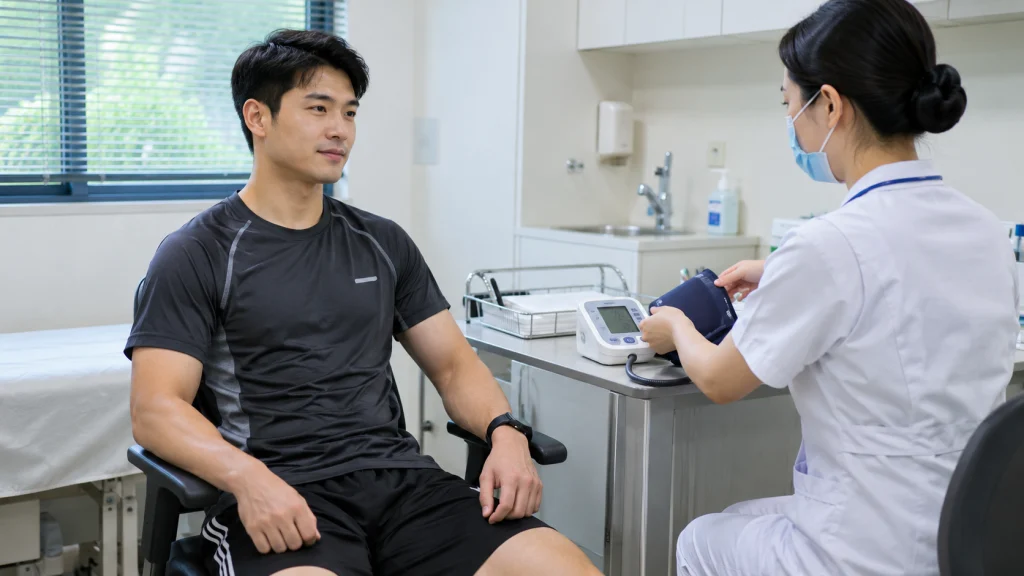
Recent exercise may affect your blood pressure reading. The American Heart Association advises avoiding exercise, caffeine, and smoking for 30 minutes before a measurement, then sitting quietly for at least five minutes.
If you’ve rushed to your appointment, tell the staff and take time to rest.
How Long Should You Rest Before Screening?
For most routine blood draws, avoid intense activity for 24 hours. EFLM guidance also recommends sitting quietly for about 15 minutes before blood collection.
The timing differs by test:
- Routine blood tests: Avoid intense exercise for about 24 hours.
- Urine albumin (uACR): Avoid intense exercise for 24 hours.
- Blood pressure: No exercise for 30 minutes beforehand; rest for at least five minutes before measurement.
The effect of particularly demanding or unfamiliar exercise can last longer than a day. If you’ve completed a marathon or an unusually heavy strength workout, ask whether you should move your appointment.
Our full body check-up packages include several blood and urine measurements. Knowing which tests you’re having can help you plan your workouts around the appointment.
Can You Exercise While Fasting?
It’s best not to. MedlinePlus advises avoiding exercise when fasting for a blood test. During a required fast, drink plain water unless your healthcare provider tells you otherwise. Avoid food, coffee, tea, juice, and flavoured drinks.
Not every screening requires fasting. Singapore’s HealthHub explains that some diabetes and cholesterol screenings can be done without it. If a fasting test is needed, the required duration depends on the test. HealthHub describes an eight- to ten-hour period for relevant screening tests.
At Love & Joy Family Clinic, our packages use non-fasting HbA1c for diabetes screening. You can review our screening tests and available add-ons before booking.
Don’t stop prescribed medication on your own. Ask the clinic whether you need to adjust medication timing, especially if you take insulin or medicine that can lower blood sugar.
What If You Already Exercised?
You may still be able to go ahead with your appointment. Tell the clinic what activity you did, how intense it was, when you finished, and whether you feel unusually sore or unwell.
Your doctor might proceed and interpret your results in context, or recommend postponing or repeating a particular test.
Don’t assume an abnormal result is caused by your workout. It may need further investigation, even if you feel perfectly fine.
Health Screening Preparation Checklist
Before your appointment:
- Confirm which tests you’re having and whether fasting is required.
- Skip strenuous exercise for 24 hours beforehand.
- Drink water normally unless you’ve been told to restrict fluids.
- Check medication instructions with your healthcare team.
- Mention supplements, recent workouts, and any current illness.
- Bring previous results if you have them.
- Arrive early enough to rest before your blood draw and blood pressure check.
You can arrange an in-clinic health screening at Love & Joy Family Clinic in Clementi. Our team can also explain the preparation requirements before your visit.
Can I Walk to My Health Screening Appointment?
Yes. An easy walk is generally fine for routine screening. Avoid rushing, and sit quietly when you arrive so your blood pressure and other measurements aren’t taken immediately after exertion.
Can Weightlifting Affect Liver Blood Tests?
Yes. Heavy lifting can increase AST and ALT, sometimes for several days. Tell your doctor about recent strength workouts rather than assuming an abnormal result must be exercise-related.
Will One Workout Change My HbA1c Result?
It’s unlikely. HbA1c reflects your average glucose over roughly three months. However, a recent workout could still influence other results taken at the same visit.
Should I Reschedule If I Exercised the Night Before?
Not always. It depends on the intensity of your workout and the tests planned. Contact the clinic for advice rather than cancelling automatically.
Can I Drink Water Before a Fasting Blood Test?
Yes, plain water is normally allowed. It can also make blood collection easier. Avoid other drinks during your fast unless your healthcare team tells you otherwise.
A little preparation helps your screening results reflect your usual health. Keep activity gentle before your appointment, follow any fasting instructions, and mention recent workouts to your doctor. To get started, contact Love & Joy Family Clinic or explore our health screening packages to find a suitable option.
References
1. EFLM-COLABIOCLI. Joint Recommendation for Venous Blood Sampling (2018).
https://www.degruyterbrill.com/document/doi/10.1515/cclm-2018-0602/html
2. Pettersson et al. Muscular Exercise Can Cause Highly Pathological Liver Function Tests in Healthy Men (2008).
https://bpspubs.onlinelibrary.wiley.com/doi/full/10.1111/j.1365-2125.2007.03001.x
3. Bongers et al. Impact of Acute Versus Prolonged Exercise and Dehydration on Kidney Function and Injury (2018).
https://pmc.ncbi.nlm.nih.gov/articles/PMC5995308
4. National Kidney Foundation. Urine Albumin-Creatinine Ratio (uACR).
https://www.kidney.org/kidney-topics/urine-albumin-creatinine-ratio-uacr
5. American Heart Association. Home Blood Pressure Monitoring.
6. HealthHub Singapore. Understanding More About Healthier SG Screening.
https://www.healthhub.sg/programmes/healthiersg-screening/screening-faq
7. MedlinePlus. Fasting for a Blood Test.